Contact us
 +34 722 619 284


 Español
 Français
 Deutsch
 Italiano
 Português PT
 Română
 Polski
 Nynorsk
 Українська
 Nederlands
 Svenska
 Čeština
 български език
 ελληνικά
 Magyar
 Eesti keel
 Slovenščina
 Latviešu valoda
 Català
 Galego
 Euskera
 Русский
CO2 Controllers for Indoor Growing
Ready to unlock the true potential of your indoor crop? With our CO2 controllers, you can automate the administration of carbon dioxide, ensuring your plants receive the exact amount they need to fatten up buds like never before. Stop guessing and start growing with precision, safety, and maximum efficiency.
 Play Text to Audio

Why your plants might be starving (even with the best nutrients)
You’ve got the premium nutrients, the latest generation LED lights, and the best genetics, but your yields are still hitting a ceiling. Does this sound familiar? The bottleneck is often invisible: Carbon Dioxide. In a sealed indoor environment, plants devour the available CO2 in minutes. Once it drops below ambient levels (around 400 ppm), photosynthesis slows down to a crawl.
Without a system to replenish and regulate this gas, you are essentially starving your plants of their main building block. It’s like trying to run a marathon while breathing through a straw. You need to keep the tank full if you want them to perform at their peak.
Mistakes that waste gas and money
Many growers try to fix this by simply cracking open a CO2 tank valve or using timers blindly. This is a recipe for disaster. First, you have no idea if you are hitting the sweet spot (1000–1500 ppm) or reaching toxic levels that can actually harm your crop. Second, without synchronization, your extraction fans might be sucking all that expensive gas right out of the room before the plants can use it.
Another classic error is dosing at night. Plants only use CO2 when the lights are on; dosing in the dark is literally throwing money into the air. Precision isn't a luxury here; it's a necessity for efficiency and safety.
How to dial in the perfect atmosphere
To get those rock-hard, heavy buds, you need to treat CO2 as a precise nutrient, not a random additive. The key is automation. A good setup involves a digital controller that constantly sniffs the air. When levels drop, it triggers your regulator; when they hit the target, it shuts off. Simple.
Remember that CO2 allows your plants to handle higher temperatures and more intense light. If you are running a powerful 1000w grow light LED setup, increasing CO2 is practically mandatory to avoid light stress and maximize that photon energy. Also, ensure your controller can coordinate with your ventilation. You want the exhaust fans off while dosing, or you're just venting cash. A smart setup often links the controller to your Indoor Extraction Kit to manage this dance perfectly.
The ultimate upgrade for heavy harvests
Installing a CO2 controller is the turning point where a hobby grow becomes a professional operation. By maintaining stable PPM levels, you can increase your yield by up to 20-30% and significantly speed up the flowering process. These devices offer the peace of mind that comes with "set it and forget it."
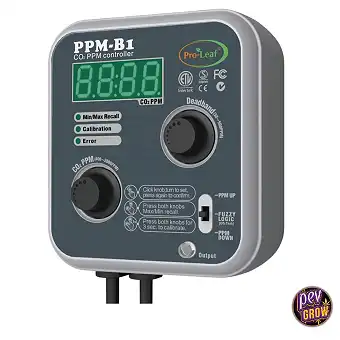
You get safety alarms, fuzzy logic to prevent overshooting, and day/night sensors. It’s not just about bigger buds; it’s about consistency. If you are serious about maximizing every square meter of your tent, precise control is the only way to go. If you are just starting to measure levels before automating, you might want to check a simple CO2 Monitor first, but eventually, full control is where the magic happens.
Frequently Asked Questions about CO2 Controllers
What is the optimal PPM level for cannabis?
Generally, during the vegetative stage, levels around 800-1000 ppm are sufficient. In flowering, you can push this up to 1200-1500 ppm, provided your temperatures and lighting intensity are high enough to support this accelerated metabolism.
Do I need a controller if I use CO2 bags?
CO2 bags produce gas continuously and cannot be turned off or regulated. A controller is designed for tank systems or burners where you can electronically open and close the flow. However, using a monitor to see if your bags are actually working is always a good idea.
Where should I place the controller probe?
The probe should be placed at plant canopy height, as that is where the gas exchange happens. Avoid placing it directly in front of the CO2 release point or near ventilation ducts to get an accurate reading of what your plants are actually breathing.
Can high CO2 levels be dangerous for me?
Yes, extremely high levels (over 5000 ppm) can be dangerous to humans. That is why quality controllers come with safety shut-offs and alarms. Always prioritize safety when working with compressed gases in sealed rooms.
Among all of you who comment or send us your questions there will be a bimonthly draw for a 50 euros voucher to buy in Pevgrow. What are you waiting for? Write now and participate!