Contact us
 +34 722 619 284


 Español
 Français
 Deutsch
 Italiano
 Português PT
 Română
 Polski
 Nynorsk
 Українська
 Nederlands
 Svenska
 Čeština
 български език
 ελληνικά
 Magyar
 Eesti keel
 Slovenščina
 Latviešu valoda
 Català
 Galego
 Euskera
 Русский
 Türkçe
Air Stone Diffusers
Your roots need to breathe to perform! Explore our selection of **air stone diffusers**, designed to turn your nutrient solution into an oxygen-rich paradise. Prevent root rot and supercharge your growth rates with the perfect bubbles.

 Play Text to Audio

The Lung of Your Hydroponic System
Let’s be real for a second: you can have the best lights and the most expensive nutrients, but if your roots are drowning, you’re going nowhere. In any indoor grow setup, especially hydroponics, dissolved oxygen is the secret sauce that separates average plants from monster yielders. Your water tank isn't just a bucket; it needs to be a living, breathing ecosystem.
Stagnant water is the enemy. It invites pathogens like Pythium (root rot) and suffocates your ladies, preventing them from drinking up those nutrients you paid good money for. This is where air stone diffusers come in to save the day. They don't just make bubbles; they create millions of micro-bubbles that drastically increase the surface area of the water, allowing for maximum oxygen absorption. Think of them as the lungs of your operation—keeping your roots white, healthy, and hungry.
How to Choose the Right Diffuser Stone
Not all stones are created equal, and picking the right one depends on your specific setup. Are you running a small DWC bucket or a massive 100-gallon reservoir? The goal is to get a uniform curtain of bubbles that agitates the water without creating a turbulent storm that damages delicate root hairs.
To get these stones working their magic, you need to pair them with a reliable air pump. If your pump is too weak, the stone won't pressurize correctly, and you'll just get a few sad bubbles trickling out. If it's too strong for a small stone, you might create too much movement. Check the airflow rating (L/min) of your pump and match it to the size of the diffuser for that sweet spot of vigorous, frothy oxygenation.
Shapes and Materials: Which One Fits Your Tank?
You’ll see a few different form factors in our catalog, and they aren't just for looks—they serve different purposes:
- Disc Stones: These are great for sitting flat on the bottom of round buckets or reservoirs. They create a wide column of bubbles rising straight up, perfect for Deep Water Culture.
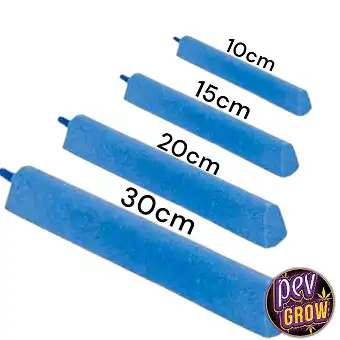
- Cylindrical Stones: Ideal for taller, narrower tanks or for tucking into corners where a disc might not fit.
- Flexible/Strip Diffusers: These can be bent to fit odd shapes or laid out to cover a larger area in rectangular trays.
Regardless of the shape, the material matters. Our stones are sintered at high temperatures to ensure they are durable and produce those fine, misty bubbles that transfer oxygen efficiently, rather than big "glug-glug" bubbles that just rise to the surface and pop without doing much.
Benefits of High-Quality Micro-Bubbles
Why obsess over bubble size? It’s simple physics. Smaller bubbles rise slower and have more total surface area than large ones, meaning they transfer more oxygen into the water before they hit the surface. High dissolved oxygen levels improve nutrient uptake efficiency and stabilize the rhizosphere environment.
When your water is well-oxygenated, it also helps maintain a stable pH level, making your life easier when you check your pH meters. Plus, the constant circulation prevents nutrient settling, ensuring your mix stays consistent from top to bottom. It’s a small investment that pays off with faster vegetative growth and heavier, denser flowers.
Frequently Asked Questions
Do I really need an air stone for soil growing?
For soil, no. But if you brew compost teas or store your water in a tank for more than 24 hours before watering, absolutely. Oxygenating your water tank keeps it fresh and dechlorinates tap water faster.
How do I clean my air stone diffuser?
Over time, salts and algae can clog the pores. To clean them, soak the stone in a mixture of water and hydrogen peroxide or a mild acid solution for a few hours, then scrub gently and rinse thoroughly. Do this between grows to keep them performing like new.
Why is my air stone only bubbling from one spot?
This usually means the air pump isn't powerful enough to push air through the entire stone, or the stone is clogged. Try a stronger pump or give the stone a deep clean. Also, make sure the stone is sitting level in the water.
Among all of you who comment or send us your questions there will be a bimonthly draw for a 50 euros voucher to buy in Pevgrow. What are you waiting for? Write now and participate!